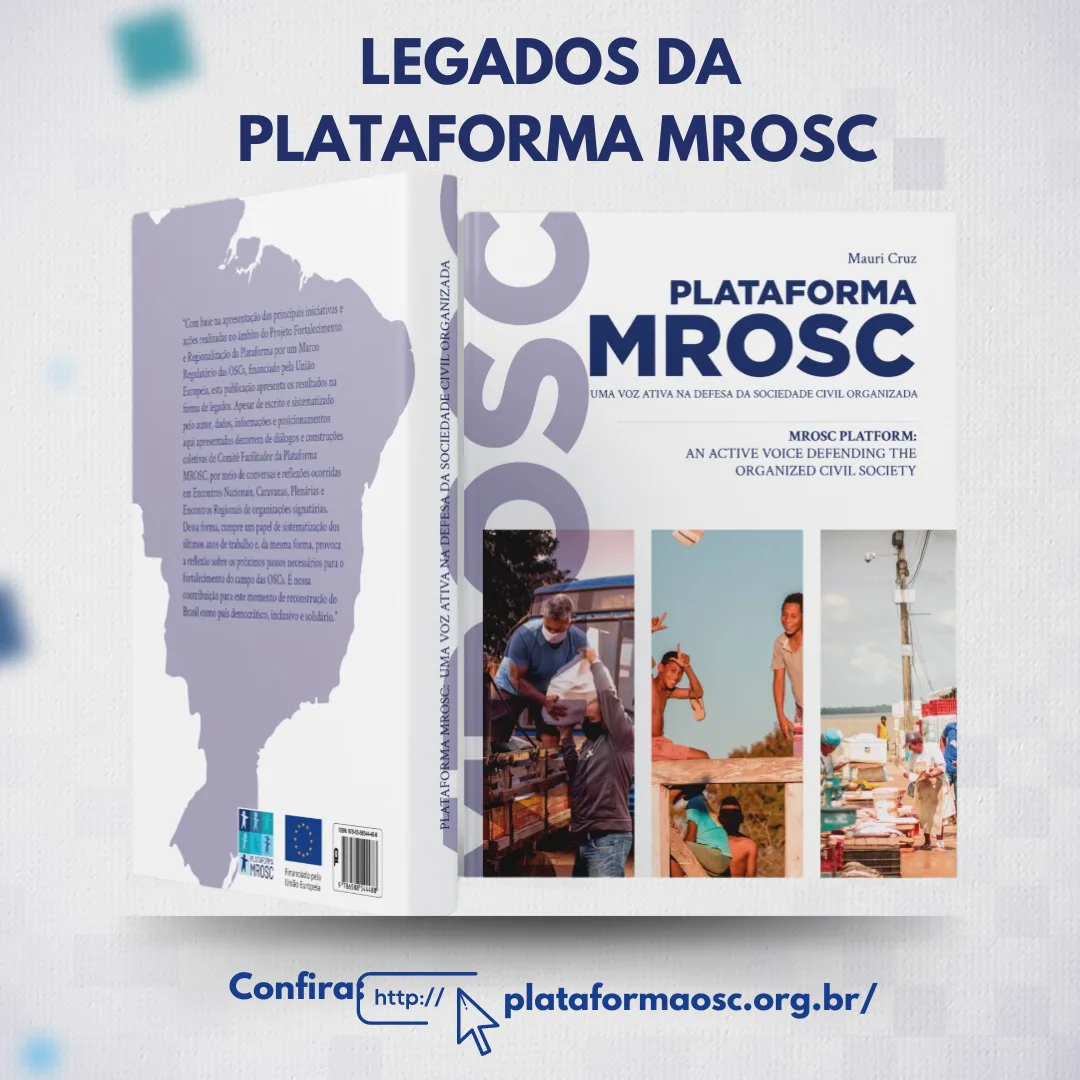
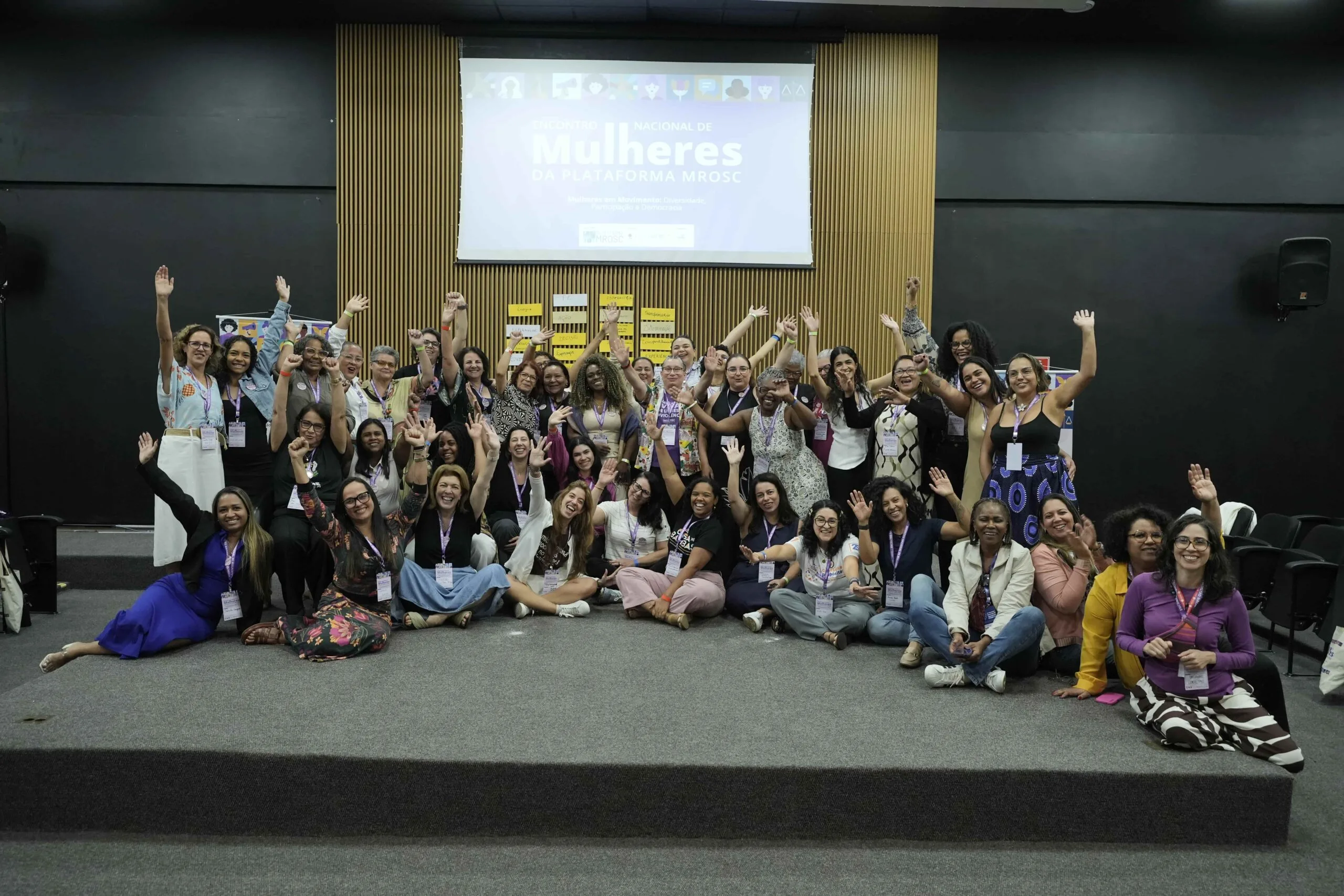
Durante o Encontro Nacional das Signatárias da Plataforma MROSC, foi lançado o livro “Plataforma MROSC: Uma Voz Ativa na Defesa da Sociedade Civil Organizada”. Um documento que representa uma valiosa memória e legado das ações realizadas pela Plataforma MROSC, abrangendo desde sua criação até o presente momento.
O lançamento foi uma ocasião especial de celebração das parcerias e das conquistas da Plataforma ao longo dos últimos anos, com foco na promoção de um ambiente favorável para as organizações, no fortalecimento das estruturas de governança e no firme compromisso com os Objetivos de Desenvolvimento Sustentável da Agenda 2030.
Na oportunidade, contamos com a presença do Comitê Facilitador da Plataforma MROSC, além da representante da União Europeia, Denise Verdade, e de Márcio Cruz da IDHE, que representou o autor do documento, Mauri Cruz.
Texto completo (transcrição)
CÁritaS BraSiLeira
eLo – LiGação e orGaniZação
Mauri Cruz
�Copyright © Cáritas Brasileira
Todos os direitos reservados e protegidos pela Lei 9.610 de 19.2.1998. Nenhuma parte deste
livro pode ser reproduzida sob quaisquer meios existentes sem autorização por escrito do/a
autor/a.
PLATAFORMA MROSC:
uma voz ativa na defesa da sociedade civil organizada
Projeto “Fortalecimento e Regionalização da Plataforma por um Novo Marco
Regulatório das Organizações da Sociedade Civil”
(CSO-LA/2018/399-177)
Este documento foi elaborado com a participação exclusiva de Cáritas Brasileira e
Elo, não podendo, em caso algum, considerar-se que reflete a posição da
União Europeia.
Brasília, DF
2023
�APRESENTAÇÃO
“substantivo feminino, ato de
dar a conhecer ou submeter algo à
apreciação de alguém.”
Fonte: Freepik.
��S umÁrio
9
23
aPresentação
de onde viemos: a luta Por
um novo marco regulatório das oscs
(2010-2016)
33
PrinciPais conquistas do novo
marco regulatório
43
55
ruPtura e covid-19 alteram o
contexto (2016-2022)
diretrizes estratégicas da
Plataforma mrosc
59
Plataforma mrosc em números
65
legados da incidência Política
83
legados de aPoio às oscs
signatárias
93
legados da ParticiPação cidadã e do
controle social
109
legados do fortalecimento da
agenda mrosc
117
legados do fortalecimento da
Plataforma mrosc
137
uma agenda Para o futuro
141
agradecimentos
144
linha do temPo
157
outras Publicações na Plataforma
mrosc
�S ummary
10
Presentation
24
Where we come from: fighting for
a new cso regulatory framework
(2010-2016)
34
Main achievements of the new
regulatory benchmark
44
Changes and breakdowns in
covid-19 context (2016-2022)
56
Strategic norms of the mrosc
platform
60
mrosc platform in numbers
66
Legacies of political advocacy
84
Supportive legacies to subscribed
csos
94
Legacies of citizen acting and
social control
110
Legacies of strengthening the
mrosc agenda
118
Mrosc platform engagements
legacies
138
An agenda for the future
142
Acknowledgements
128
The timeline
146
Another releases about mrosc
plataform
�A presentação
Para que servem as Organizações da Sociedade Civil (OSCs)? Qual a
importância dessas organizações para a garantia da efetividade dos direitos
básicos da sociedade brasileira? Qual a verdadeira contribuição das OSCs
para o desenvolvimento econômico, social, político, cultural e ambiental do
Brasil?
Essas são perguntas básicas que certamente povoam o pensamento
daqueles que não convivem de forma direta com o fazer das mais de 800 mil
OSCs brasileiras.
PLATAFORMA MROSC: UMA VOZ ATIVA NA DEFESA DA SOCIEDADE CIVIL ORGANIZADA
9
�P resentation
What are Civilian Society Organizations (CSOs) for? What is the
importance of these organizations to ensure the effectiveness of basic rights
in Brazilian society? What is the real contribution of CSOs to the economic,
social, political, cultural and environmental development of Brazil?
These are basic questions that certainly populate the thoughts of
those who do not live directly with the work of the more than 800 thousand
Brazilian CSOs.
10
MROSC PLATFORM: AN ACTIVE VOICE DEFENDING THE ORGANIZED CIVIL SOCIETY
�Para um observador mais atento, as respostas aos questionamentos a
respeito da existência das organizações da sociedade civil sempre estiveram
presentes na vida do povo brasileiro, em especial nas parcelas excluídas de
uma sociedade profundamente desigual. São os ativistas das OSCs as primeiras pessoas a chegarem em qualquer recanto do país quando as crises acontecem.
A pandemia de covid-19 é um exemplo recente e bastante singular dessa afirmativa. Foram as OSCs as primeiras organizações a se darem conta do
drama da fome de milhões de famílias que, do dia para a noite, ficaram proibidas de sair às ruas para batalhar por seu ganha pão diário. Num país com
48% da mão de obra economicamente ativa vivendo de trabalhos informais,
subempregos ou empregos terceirizados¹, o isolamento teve como consequência direta e imediata a fome. Os governos demoraram tempo demais
para perceber a situação. Assim, a própria sociedade civil tomou a dianteira
do apoio emergencial e da solidariedade, mobilizando pessoas, criando comitês populares e arrecadando doações e recursos.
1 ALVARENGA,
Darlan;
CAVALINI, Marta.
Brasil perde
2,8 milhões de
trabalhadores
com carteira
em 8 anos;
informalidade
e conta própria
crescem. G1,
Rio de Janeiro,
15 maio 2022.
Disponível em:
Acesso em: 5 jul.
2023.
A Plataforma MROSC não
utiliza o conceito terceiro
setor por compreender
que ele não representa
de forma adequada
as organizações da
sociedade civil, no entanto
mantivemos o termo na
apresentação dos dados
para não alterar o sentido
da pesquisa realizada.
PLATAFORMA MROSC: UMA VOZ ATIVA NA DEFESA DA SOCIEDADE CIVIL ORGANIZADA
11
�ALVARENGA, 1
Darlan;
CAVALINI,
Marta. Brazil
loses 2.8 million
workers with a
license in 8 years;
informality and
self-employment
grow. G1, Rio de
Janeiro, May 15,
2022.
Available at:
Accessed on: July
5, 2023
12
To a closer observer, however, the answers to civil society organizations have always been present in the lives of the brazilian people, especially
in the excluded portions of a deeply unequal society. CSO activists are the
first people to arrive in any corner of the country when crises strike.
The covid-19 pandemic is a recent and very unique example of this
statement. CSOs were the first organizations to realize the hunger’s drama to
millions of families who, overnight, were forbidden to go out into the streets
to fight for their daily meal. In a country with 48% of the economically active
workforce living on informal jobs, underemployment or outsourced jobs¹,
isolation had the direct and immediate consequence of hunger. Governments
took too long to realize the situation, so civilian society itself took the lead in
emergency support and solidarity, mobilizing people, creating popular committees and collecting donations and resources.
The MROSC Platform
doesn’t use the third
sector concept because
it is an inadequate
portrayal of civilian society
organizations, however,
we kept the term in the
presentation of the data so
as not to alter the meaning
of the research carried out.
MROSC PLATFORM: AN ACTIVE VOICE DEFENDING THE ORGANIZED CIVIL SOCIETY
�Conclui-se que são as OSCs as
principais organizações presentes no
cotidiano dos milhões de brasileiras
e brasileiros que passam fome, vivem em situação de rua, sem acesso
à saúde, sem moradia, sem condições
dignas de trabalho, de educação, de
assistência social, de cultura e de
proteção ambiental. As OSCs são
relevantes porque canalizam os sentimentos de solidariedade e de compromisso mútuo por uma sociedade
verdadeiramente inclusiva, capaz de
garantir a dignidade humana a toda e
qualquer pessoa.
Além disso, as OSCs possuem
importância econômica. Um estudo recente² demonstra que as OSCs
são responsáveis por quase 4,27% do
PIB nacional e empregam mais de 6
milhões de pessoas, na sua maioria
mulheres com escolaridade de nível
superior. O trabalho desse grupo
funciona como um verdadeiro laboratório de tecnologias sociais, econômicas, culturais e ambientais que,
quando incorporadas às políticas públicas, têm o potencial de contribuir
com a superação da maioria das crises decorrentes de um sistema econômico que prioriza a acumulação
de capital em detrimento da defesa e
proteção da vida.
2 A IMPORTÂNCIA
do Terceiro
Setor para o
PIB no Brasil.
Movimento
Arredondar, [s.
l.], 28 mar. 2023.
Disponível em:
Acesso em: 9 jul.
2023.
Fonte: A importância do terceiro setor para o PIB no Brasil. Sitawi, [s. l.], 2022. Disponível
em:https://sitawi.net/wp-content/uploads/2023/03/miolo_terceirosetor-resumoweb2003.pdf.
PLATAFORMA MROSC: UMA VOZ ATIVA NA DEFESA DA SOCIEDADE CIVIL ORGANIZADA
13
�The 2
relevance of the
third sector for
GDP in Brazil.
Movimento
Arredondar, [s.
l.], 28 Mar. 2023.
Available at:
The CSOs are currently one
of the most significant and essential
organizations in millions of Brazilians’ daily lives, especially for those
who are hungry, homeless and without access to health, housing, decent working conditions, education,
social assistance, culture, and environmental protection. It’s important
to acknowledge CSOs’ relevance in
conducting the feelings of solidarity
and mutual commitment for a truly
inclusive society, capable of ensuring
human dignity to every person.
Besides that, CSOs also have
economic importance. A recent
study² shows that CSOs are responsible for almost 4.27% of the national GDP and employ more than 6
million people, mostly highly educated women. The group’s work creates a genuine laboratory of social,
economic, cultural and environmental technologies that can be incorporated into public policies, and contribute to going through most types
of crises that arise from an economic
system, which prioritizes the accumulation of capital instead of defending and protecting people’s life.
Accessed on: July
9, 2023.
Source: The importance of the third sector for GDP in Brazil. Sitawi, [s. l.], 2022. Available at:
https://sitawi.net/wp-content/uploads/2023/03/miolo_terceirosetor-resumo-web2003.pdf.
14
MROSC PLATFORM: AN ACTIVE VOICE DEFENDING THE ORGANIZED CIVIL SOCIETY
�Fonte: A importância do terceiro setor para o PIB no Brasil. Sitawi, [s. l.], 2022. Disponível em: https://
sitawi.net/wp-content/uploads/2023/03/miolo_terceirosetor-resumo-web2003.pdf.
Fonte: A importância do terceiro setor para o PIB no Brasil. Sitawi, [s. l.], 2022. Disponível em: https://
sitawi.net/wp-content/uploads/2023/03/miolo_terceirosetor-resumo-web2003.pdf.
PLATAFORMA MROSC: UMA VOZ ATIVA NA DEFESA DA SOCIEDADE CIVIL ORGANIZADA
15
�Source: The importance of the third sector for GDP in Brazil. Sitawi, [s. l.], 2022. Available at: https://
sitawi.net/wp-content/uploads/2023/03/miolo_terceirosetor-resumo-web2003.pdf.
Source: The importance of the third sector for GDP in Brazil. Sitawi, [s. l.], 2022. Available at: https://
sitawi.net/wp-content/uploads/2023/03/miolo_terceirosetor-resumo-web2003.pdf.
16
MROSC PLATFORM: AN ACTIVE VOICE DEFENDING THE ORGANIZED CIVIL SOCIETY
�Surpreende aos desinformados que as OSCs tenham tamanha relevância e ainda ajam com competência e enorme capacidade de gestão. Pesquisa
realizada pela organização suíça The Dot Good³ mapeou as 50 organizações
sociais brasileiras mais influentes com base na análise de critérios como incidência política, grau de transparência, níveis de gestão e governança. Uma
das principais conclusões dessa pesquisa é que as iniciativas das diversas organizações brasileiras estão alinhadas com os Objetivos de Desenvolvimento
Sustentável (ODS) da Organização das Nações Unidas (ONU), contribuindo
para o cumprimento das metas estabelecidas pela Agenda 2030, como a erradicação da pobreza, o combate à fome, a igualdade de gênero, o empoderamento das mulheres, a redução das desigualdades e o combate às mudanças
climáticas.
Neste momento, o leitor e a leitora devem estar se perguntando: se
as OSCs são tão importantes para o Brasil, por que elas são perseguidas? Por
que não recebem apoio e investimentos para seu funcionamento? Por que são
marginalizadas e criminalizadas por representantes do poder público e parte
da mídia corporativa?
A resposta certamente é porque as OSCs brasileiras, além de atuarem
de forma emergencial e imediata para minimizar os dramas sociais do povo
brasileiro, também lutam por mudanças estruturais, visando a superação das
causas que produzem esses dramas: concentração de terras e riquezas, desigualdade, racismo, desemprego, lucros exorbitantes, patriarcado, precarização do trabalho, preconceitos sociais e sexuais, desrespeito ao meio ambiente, entre tantas outras causas. Uma parcela das OSCs se articula justamente
para mudar as estruturas de poder que mantêm o Brasil como uma das sociedades mais desiguais e injustas do mundo. Ao lutar por mudanças, essas
organizações mexem com os interesses de poderes econômicos que resistem
para manter privilégios e status sociais. As OSCs são criminalizadas porque
as ações e iniciativas promovidas, além de atenderem às emergências e urgências da população pobre brasileira, buscam a transformação social.
Esta publicação tem como objetivo provocar uma reflexão sobre essas
questões por meio da experiência da Plataforma MROSC nos últimos anos.
Assim, apresenta-se, de forma sucinta, a história dessa rede de organizações
da sociedade civil criada em 2010 para exigir do estado brasileiro o reconhecimento das OSCs como sujeito de direitos pela construção de um novo
marco regulatório, denominado Plataforma por um novo Marco Regulatório
das OSCs, ou, simplesmente, Plataforma MROSC.
PLATAFORMA MROSC: UMA VOZ ATIVA NA DEFESA DA SOCIEDADE CIVIL ORGANIZADA
3 ONGs brasileiras
estão entre as
mais relevantes
do mundo
em ranking.
Observatório do
Terceiro Setor,
São Paulo, 23
jun. 2023.
Disponível em:
Acesso em: 9 jul.
2023.
17
�Brazilian NGOs 3
are among the
most relevant
in the world
in ranking.
Observatório do
Terceiro Setor,
São Paulo, June
23, 2023.
Available at:
Accessed on: July
9, 2023.
18
Many people who are not well-informed may be surprised to learn
that CSOs (Civil Society Organizations) hold a significant level of relevance
and are known for their competence and exceptional management abilities.
A research conducted by the Swiss organization The Dot Good has cataloged
the 50 most influential Brazilian social organizations based on the analysis
of norms such as political incidence, degree of transparency, management levels and governance. One of the main conclusions of this research is that the
initiatives of the various Brazilian organizations are aligned with the Sustainable Development Goals (SDGs) of the United Nations (UN), contributing to the achievement of the goals established by the 2030 Agenda, such as
eradicating poverty, fighting hunger, gender equality, empowering women,
reducing inequalities and combating climate changes
At this point, you may be asking yourself: if CSOs are so important
for Brazil, why are they being persecuted? Why do they not receive support
and investments for their operation? Why are they marginalized and criminalized by public authorities representatives and part of the corporate media?
The reason is that Brazilian CSOs act quickly to address social crises in
a way to minimize Brazilian people’s social drama. CSOs are also fighting for
structural changes, aiming to overcome the causes that produce these dramas: concentration of land and wealth, inequality, racism, unemployment,
exorbitant profits, patriarchy, the precariousness of work, social and sexual
prejudices, disrespect for the environment, among many other causes. A part
of CSOs articulates itself precisely to change the power structures that hold
Brazil as one of the most unequal and unjust societies throughout the world.
By fighting for change, these organizations touch the interests of economic
powers that resist maintaining privileges and social status. CSOs are criminalized because the actions and initiatives they promote seek social transformation, besides addressing the emergencies and urgencies of the poor Brazilian population,.
This book aims to instigate a reflection on these issues through the experience of the MROSC Platform in recent years. Thus, it briefly presents the
history of this network of civilian society organizations created in 2010 to
demand from the Brazilian state the recognition of CSOs as subjects of rights
by the construction of a new regulatory framework for CSOs, called Platform
for a new CSO Regulatory Framework, or simply MROSC Platform.
MROSC PLATFORM: AN ACTIVE VOICE DEFENDING THE ORGANIZED CIVIL SOCIETY
�Atualmente, a Plataforma MROSC
conta com mais de 2 mil organizações
signatárias, cuja rede indireta alcança
mais de 100 mil organizações, e
busca ampliar e enraizar a sua
atuação, trazendo cada vez mais
organizações para o debate sobre o
ambiente regulatório e institucional
das organizações da sociedade civil
no Brasil, em nível federal, distrital,
estadual e municipal, promovendo
articulação e intercâmbio entre as
experiências e práticas existentes.
Com base na apresentação das principais iniciativas e ações realizadas no âmbito do Projeto Fortalecimento e Regionalização da Plataforma
por um Marco Regulatório das OSCs, financiado pela União Europeia, esta
publicação apresenta os resultados na forma de legados. Apesar de escrito
e sistematizado pelo autor, os dados, as informações e os posicionamentos
aqui apresentados decorrem de diálogos e construções coletivas do Comitê
Facilitador da Plataforma, bem como de conversas e reflexões ocorridas em
Encontros Nacionais, Caravanas, Plenárias e Encontros Regionais de organizações signatárias da Plataforma.
Dessa forma, esta publicação cumpre um papel de sistematização dos
últimos anos de trabalho e, da mesma forma, provoca a reflexão sobre os
próximos passos necessários para o fortalecimento do campo das OSCs. É,
portanto, nossa contribuição para este momento de reconstrução do Brasil
como país democrático, inclusivo e solidário.
PLATAFORMA MROSC: UMA VOZ ATIVA NA DEFESA DA SOCIEDADE CIVIL ORGANIZADA
19
�Nowadays, the MROSC Platform
has more than 2 thousand signatory
organizations, whose indirect network
reaches more than 100 thousand
organizations and seeks to expand
and root its performance, bringing
more and more organizations to
the debate on the regulatory and
institutional environment of civil
society organizations in Brazil, at the
federal, district, state and municipal
levels, promoting articulation and
exchange between existing experiences
and practices.
Based on the presentation of the main initiatives and actions carried
out within the scope of the Project Strengthening and Regionalization of the
Platform for a CSO Regulatory Framework, funded by the European Union,
this publication presents the results in the form of legacies. Although written
and systematized by the author, the data, information and positions presented here result from dialogues and collective constructions of the Platform’s
Facilitating Committee, as well as from conversations and reflections that
took place in National Meetings, Caravans, Plenaries and Regional Meetings
of signatory organizations of the Platform.
Thus, this publication fulfills the role of systematizing the last years of
work and, likewise, provokes reflection on the next steps necessary to strengthen the field of CSOs. It is, therefore, our contribution to this moment of
reconstruction of Brazil as a democratic, inclusive and supportive country.
20
MROSC PLATFORM: AN ACTIVE VOICE DEFENDING THE ORGANIZED CIVIL SOCIETY
�Fonte: acervo da Plataforma MROSC.
�Source: MROSC Platform collection.
�D e onde viemos : a luta por
um novo marco regulatório
das osc s (2010-2016)
Quem se preocupa em criar um ambiente favorável para a atuação das
organizações da sociedade civil? Uma pergunta intrigante porque, apesar da
relevância das OSCs para o país, a invisibilidade delas como sujeito político
e como detentoras de direitos remonta à sua própria existência. Essa invisibilidade tem sido construída por quem deseja manter o país como sociedade
desigual e vê na atuação das OSCs o potencial de mudanças. Garantir o reconhecimento dessas entidades e, a partir daí, criar um ambiente favorável para
a atuação da sociedade civil organizada é tarefa para todos aqueles que lutam
por transformações sociais em prol de uma sociedade mais justa.
Nesse sentido, embora a Plataforma MROSC tenha sido criada apenas em 2010, é necessário reconhecer que o embrião dessa rede já existia,
mesmo que informalmente, desde o processo constituinte de 1988. Naquele
momento de abertura política pós-Ditadura Militar, várias organizações da
sociedade civil se articularam para defender a autonomia e a liberdade de
organização do povo brasileiro, vedando qualquer forma de interferência do
estado em seu funcionamento, conquista que está esculpida nos incisos XVII
e XVIII do art. 5º da Constituição Federal.
Art. 5º Todos são iguais perante a lei, sem distinção de
qualquer natureza, garantindo-se aos brasileiros e aos
estrangeiros residentes no País a inviolabilidade do direito à
vida, à liberdade, à igualdade, à segurança e à propriedade, nos
termos seguintes:
XVI – todos podem reunir-se pacificamente, sem armas, em
locais abertos ao público, independentemente de autorização,
desde que não frustrem outra reunião anteriormente
convocada para o mesmo local, sendo apenas exigido prévio
aviso à autoridade competente;
XVII – é plena a liberdade de associação para fins lícitos, vedada
a de caráter paramilitar;
XVIII – a criação de associações e, na forma da lei, a de
cooperativas independem de autorização, sendo vedada a
interferência estatal em seu funcionamento;
XIX – as associações só poderão ser compulsoriamente
dissolvidas ou ter suas atividades suspensas por decisão
PLATAFORMA MROSC: UMA VOZ ATIVA NA DEFESA DA SOCIEDADE CIVIL ORGANIZADA
23
�W here we come from :
fighting for a new cso
regulatory benchmark
(2010-2016)
Who is concerned with creating a good environment for civilian society organizations to act out? This is a thought-provoking question. Despite
the importance of CSOs to the country, their invisibility as political subjects
and as duty-bearers reassembles to their very existence. This invisibility has
been built by those who wish to maintain the country as an unequal society
and see in the performance of CSOs the potential for change. Ensuring the
recognition of these entities and, from there, creating a favorable environment for the performance of CSOs of organized civil society is a task for all
those who strive for social change towards a fairer society.
In this direction, although the creation of MROSC Platform was only
in 2010, it is necessary to recognize that the embryo of this network has already existed, even if informally, since the 1988 constituent process.In that
moment of political opening after the military dictatorship, several civil society organizations articulated themselves to defend the autonomy and freedom of organization of the Brazilian people, prohibiting any form of state
interference in their functioning, a sculpted achievement in sections XVII
and XVIII of art. 5 of the Federal Constitution.
Art. 5 All are equal before the law, without distinction of any
kind, guaranteeing Brazilians and foreigners residing in the
country the inviolability of the right to life, liberty, equality,
security and property, under the following terms:
XVI – everyone is allowed to assemble peacefully, without
weapons, in places open to the public, regardless of
authorization, provided that they do not frustrate another
meeting previously convened for the same place, only prior
notice to the competent authority being required;
XVII – free association for lawful purposes is permitted, except
the paramilitary ones;
XVIII – the creation of associations and, in the form of the
law, cooperatives are independent of authorization, and state
interference in their operation is prohibited;
XIX – associations may only be compulsorily dissolved or have
their activities suspended by a court decision, requiring, in the
first case, the final judgment;
24
MROSC PLATFORM: AN ACTIVE VOICE DEFENDING THE ORGANIZED CIVIL SOCIETY
�judicial, exigindo-se, no primeiro caso, o trânsito em julgado;
XX – ninguém poderá ser compelido a associar-se ou a
permanecer associado;
XXI – as entidades associativas, quando expressamente
autorizadas, têm legitimidade para representar seus filiados
judicial ou extrajudicialmente […]⁴.
4 BRASIL.
[Constituição
(1988)].
Constituição
da República
Federativa do
Brasil: texto
constitucional
promulgado em
5 de outubro
de 1988, com
as alterações
determinadas
pelas Emendas
Constitucionais
de Revisão
nos 1 a 6/94,
pelas Emendas
Constitucionais
nos 1/92 a
91/2016 e
pelo Decreto
Legislativo
no 186/2008.
Brasília, DF:
Senado Federal:
Coordenação
de Edições
Técnicas, 2016.
Disponível em:
Acesso em: 11 jul.
2023.
Fonte: 30 anos da Constituição Cidadã. Senado Federal/Câmera dos Deputados, Brasília. Disponível em:
https://www.camara.leg.br/internet/agencia/infograficos-html5/constituinte/index.html.
Após a promulgação da Constituição Cidadã, boa parte das organizações seguiram cumprindo um importante papel na discussão e implementação de políticas públicas nacionais, como a criação do Sistema Único de
Saúde (SUS), o Sistema Único de Assistência Social (Suas), a Lei de Diretrizes
e Bases da Educação Nacional (LDB), o Estatuto das Cidades, o Estatuto da
Pessoa Idosa, o Estatuto da Igualdade Racial, o Estatuto da Pessoa com Deficiência, entre tantas outras leis e normas de garantia de direitos. Inicialmente,
todas essas mudanças foram pensadas como políticas públicas a serem implementadas e efetivadas pelo próprio Estado por meio de seus órgãos e entidades, cabendo à sociedade civil organizada o acompanhamento, a fiscalização
e a avaliação dessas políticas.
No entanto, a partir dos anos 1990 a 2002, a adoção pelos governos das
concepções neoliberais, alimentada pela pressão de setores privados, consolidou-se como uma campanha permanente para o enxugamento do Estado
PLATAFORMA MROSC: UMA VOZ ATIVA NA DEFESA DA SOCIEDADE CIVIL ORGANIZADA
25
�BRAZIL 4
[Constitution
(1988)].
Constitution of
the Federative
Republic
of Brazil:
constitutional
text
promulgated on
October 5, 1988,
as amended by
Constitutional
Amendments
Nos. 1 to 6/94,
Constitutional
Amendments
Nos. 1/92 to
91/2016 and
Legislative
Decree No.
186/2008.
Brasília, DF:
Federal Senate:
Coordination
of Technical
Editions, 2016.
Available at:
XX – no one has to be forced to join or remain as an association
member;
XXI – associative entities, when expressly authorized,
have legitimacy to represent their affiliates judicially or
extrajudicially […]4
Accessed on:
July 11, 2023.
Source: MROSC Platform collection.
After the announcement of Citizen Constitution, many organizations
have continued to execute an important function related to the debate of national public policies implementary actions, such as the creation of the Unified Health System (SUS), the Unified Social Assistance System (Suas), the
Law of Norms and Bases to National Education (LDB), the Statute of Cities,
the Statute of the Elderly, the Statute of Racial Equality, the Statute of Persons with Disabilities, among many other laws and norms wich guaranteeing
rights. At the beginning, all these changes were thought as public policies to
be implemented and accomplished by state itself through its agencies and entities; consequently, organized civilian society is responsible for monitoring,
supervising and evaluating these policies.
However, from the 1990s to 2002, neoliberal government ideology,
fueled by private sectors pressure, was consolidated as a permanent campaign for downsizing Brazilian state, reducing resources, scrapping public
structures, dismissing government employees and suspending new government exams, which resulted in a reduction of state’s capacity to develop
26
MROSC PLATFORM: AN ACTIVE VOICE DEFENDING THE ORGANIZED CIVIL SOCIETY
�brasileiro, com a redução de recursos, o sucateamento das estruturas públicas, a demissão de servidores e a suspensão de novos concursos públicos,
resultando na redução do desenvolvimento de políticas públicas. O conjunto
de ideias neoliberais de enxugamento da capacidade de ação do Estado e de
retirada de direitos repercutiu na queda da renda dos segmentos mais vulneráveis da sociedade, o que gerou aumento da fome e do desemprego, além de
déficit social.
Como alternativa, o próprio poder público passou a demandar que
as OSCs assumissem parte da execução de várias dessas políticas. Esse novo
momento colocou um dilema no âmbito das organizações da sociedade civil,
que, do lugar de apoiadoras de movimentos sociais por políticas públicas,
passaram a ocupar a função e o papel de executoras dessas ações.
É importante dizer que as parcerias entre o Estado e as organizações
da sociedade civil não é tema novo. Desde o século passado, organizações se
ocupavam de cuidar das pessoas marginalizadas pela sociedade e, para isso,
muitas vezes contavam com aporte financeiro do próprio Estado por meio de
transferências voluntárias de recursos públicos. Ocorre que, a partir de 1993,
com a criação da Lei das Licitações, toda e qualquer transferência de recursos
públicos obrigatoriamente deve passar por processo licitatório ou, de forma
excepcional, ser demonstração de que a seleção pública é inviável – nesse
caso, a não realização da licitação deve ser justificada.
Assim, surgiu uma dificuldade quanto aos repasses voluntários de recursos que, num primeiro momento, produziu situações críticas de desfinanciamento das ações realizadas pela OSCs. A Lei das Licitações, por meio dos
artigos 25 e 116, permitia a celebração de convênios envolvendo os órgãos
públicos. Essa brecha legal acabou sendo utilizada de forma ampla para a celebração das parcerias com as OSCs.
Não havendo um instrumento jurídico próprio para a realização dessas parcerias, os órgãos públicos delinearam-nas da forma como mais lhe interessava, transferindo para as OSCs todas as obrigações inerentes à execução
das políticas públicas somadas à burocracia estatal. Esse novo contexto gerou
enorme insegurança jurídica para a atuação das organizações da sociedade
civil, que se viram envolvidas em processos jurídicos, denúncias, coação por
parte de gestores públicos, além dos riscos de devolução de recursos.
Para enfrentar esse quadro, em 2010, dezenas de organizações se reuniram para criar a Plataforma por um Novo Marco Regulatório das Organizações da Sociedade Civil, a Plataforma MROSC. Rapidamente, a Plataforma
MROSC tornou-se uma importante rede de articulação de organizações sem
fins lucrativos e de interesse público com o objetivo de aprimorar o ambiente
social e legal de atuação das organizações da sociedade civil em todo o Brasil.
Já em 2010 obteve compromisso assinado pelos candidatos à Presidência da
PLATAFORMA MROSC: UMA VOZ ATIVA NA DEFESA DA SOCIEDADE CIVIL ORGANIZADA
27
�public policies. The neoliberal policy, which has been reducing the state’s
c capability to act, reducing civil rights; furthermore, impacting on the financial decrease of most vulnerable segments of society, which has led to an
increase in hunger, unemployment and social deficit.
As an alternative, the public authorities themselves began to demand
that CSOs take part in implementing several of these policies. This new moment created a dilemma for CSOs that started in a position of supporters of
social movements for public policies andbegan to occupy spaces and roles as
executors of these same policies.
It is important to say that partnerships between the state and civilian society organizations are not a new. Since the last century, organizations
have taken care of marginalized people in society and these same organizations often had financial support from the state through voluntary transfers
of public resources.
Since 1993, with the creation of the Bidding Law, any and all transfers
of public funds must go through a bidding process or, exceptionally, be demonstrated that public selection is unfeasible and in this case, the non-realization of the bidding must be justified.
An impasse arose concerning voluntary transfers of resources that,
at first, produced critical situations of de-financing the actions carried out
by CSOs. The Bidding Law, through articles 25 and 116, allowed the signing
of agreements involving public bodies. This legal loophole ended up being
widely used to enter into partnerships with CSOs.
Since there was no specific legal instrument to rulethese partnerships,
public bodies outlined them in the way that most interested them, transferring to CSOs all the obligations inherent to the execution of public policies
added to the state bureaucracy. This new context generated enormous legal
uncertainty for the performance of civil society organizations, which found
themselves involved in legal proceedings, complaints and coercion by public
managers, in addition to the risks of returning resources.
To address this situation, in 2010, dozens of organizations came together to create the Platform for a New Regulatory Framework for Civil Society
Organizations, the MROSC Platform. The MROSC Platform quickly became an important network of non-profit and public interest organizations to
improve the social and legal environment for civilian society organizations
throughout Brazil. In 2010, it obtained a commitment signed by the candidates for the Presidency of the Republic, Dilma Rousseff and José Serra, who
competed in the second round of the elections that year. The commitment
made by both was that the elected one would ensure the implementation of
a favorable regulatory environment and the creation of policies to promote
CSOs. Elected, President Dilma composed a Joint Working Group formed
28
MROSC PLATFORM: AN ACTIVE VOICE DEFENDING THE ORGANIZED CIVIL SOCIETY
�República, Dilma Rousseff e José Serra, que disputaram o segundo turno
das eleições daquele ano. O compromisso assumido por ambos foi de que
o eleito garantiria a implantação de um ambiente regulatório favorável e a
criação de políticas de fomento às OSCs. Eleita, a presidenta Dilma compôs um Grupo de Trabalho Paritário formado pelo governo federal, por
integrantes da Plataforma MROSC e por outras redes e organizações para
a elaboração da proposta, que, após negociada com o Congresso Nacional,
tornou-se a Lei 13.019/2014.
A nova legislação – Lei das Parcerias – reconhece o papel das organizações da sociedade civil, citadas pela primeira vez com esse conceito no ordenamento jurídico brasileiro, bem como simplifica e uniformiza as regras para
as parcerias entre poder público e organizações da sociedade civil, garantindo
maior transparência e segurança no repasse e na aplicação dos recursos para
as políticas públicas implementadas pelas OSCs. É uma lei que deve ser aplicada por todos os entes públicos – União, Distrito Federal, estados e municípios – e tornou-se uma poderosa ferramenta para garantir a capacidade de
atuação das OSCs nas relações de parceria com os governos.
Fonte: acervo da Plataforma MROSC.
PLATAFORMA MROSC: UMA VOZ ATIVA NA DEFESA DA SOCIEDADE CIVIL ORGANIZADA
29
�by the federal government, members of the MROSC Platform, and other networks and organizations to draft the proposal that, after negotiating with
the National Congress, became Law 13.019/2014.
The new Law 13.019/2014 recognizes the role of civil society organizations, mentioned for the first time with this concept in the Brazilian legal
order, simplifies and standardizes the rules for partnerships between public
authorities and civil society organizations, ensuring greater transparency
and security in the transfer and application of resources for public policies
implemented by CSOs. It is a law that must be applied by all public entities – Union, Federal District, states and municipalities – and has become a
powerful tool to ensure the ability of CSOs to act in partnership relations
with governments.
Source: MROSC Platform collection.
30
MROSC PLATFORM: AN ACTIVE VOICE DEFENDING THE ORGANIZED CIVIL SOCIETY
�A Plataforma MROSC, por sua capacidade de articulação e incidência política, tornou-se sujeito fundamental nessa conquista, em especial para
manter os princípios da autonomia das OSCs, da transparência e do interesse
público na aplicação dos recursos, buscando o fortalecimento das organizações da sociedade civil nas relações de parceria com o Estado.
Sancionada a lei, a Plataforma vem cumprindo um importante papel
na disseminação da nova norma entre estados e municípios, realizando processos de formação e de capacitação por todo o país por meio de suas signatárias, atuando para garantir que o espírito original da lei não seja corrompido
no momento de sua implementação.
Fonte: elaborado com base na Plataforma MROSC.
PLATAFORMA MROSC: UMA VOZ ATIVA NA DEFESA DA SOCIEDADE CIVIL ORGANIZADA
31
�The MROSC Platform, due to its capacity for articulation and political
advocacy, has become a fundamental subject in this achievement, especially
to maintain the principles of CSO autonomy, transparency and public interest to apply resources, seeking to strengthen civil society organizations in
partnership relations with the State.
The Platform played a role in disseminating the new norm among states and municipalities once the government sanctioned the law. It carried out
training and capacity-building processes throughout the country through its
signatories, ensuring the original spirit and accuracy of the law at the time of
its implementation.
Source: data from MROSC Platform, 2023.
32
MROSC PLATFORM: AN ACTIVE VOICE DEFENDING THE ORGANIZED CIVIL SOCIETY
�P rincipais conquistas do
novo marco regulatório
A forma como alguns entes públicos têm interpretado e aplicado a Lei
das Parcerias vem gerando dúvidas e estranhamentos em relação a sua aprovação. Desde 2016, a Plataforma MROSC tem acompanhado todo o processo
de implementação da Lei das Parcerias, inicialmente na União e nos estados,
e, a partir de janeiro de 2017, nos municípios. É possível verificar que um expressivo número de administrações públicas não compreendeu as mudanças
substanciais que foram implementadas no ordenamento jurídico brasileiro
com a sanção da Lei 13.019/2014. Por desconhecimento ou por falta de interesse, muitos gestores públicos mantiveram antigos procedimentos que não
possuem mais guarida legal. Esse comportamento, muitas vezes, confunde
as próprias organizações da sociedade civil, que acreditam que as mudanças
não vieram para qualificar o ambiente das parcerias e facilitar a atuação delas.
Aproveitamos esta publicação para listar as mudanças que, no entender da Plataforma MROSC, são as mais relevantes na ótica das organizações
da sociedade civil.
O princípio é a
parceria
A Lei 13.019/2014 estabelece que o princípio que
rege a relação das OSCs com a Administração
Pública é a parceria. Nesse princípio, não cabe a
lógica de contratação de serviços ou de hierarquia
entre os partícipes da parceria. Da mesma
forma, impõe responsabilidades conjuntas e
reciprocidades nos riscos e resultados das atividades
realizadas. Os parceiros não impõem regras nem
estabelecem procedimentos unilaterais. Só valem
os procedimentos acordados e formalizados nos
termos de fomento ou de colaboração.
PLATAFORMA MROSC: UMA VOZ ATIVA NA DEFESA DA SOCIEDADE CIVIL ORGANIZADA
33
�M ain achievements of the
new regulatory benchmark
The way in which some public entities have interpreted and applied
the Law on Partnerships has generated doubts and strangeness concerning
its approval. Since 2016, the MROSC Platform has followed the entire
implementation process of the Partnership Law, initially in the Union and in
the States, and, as of January 2017, in the municipalities. Since the sanction
of Law 13.019/2014, the Brazilian legal system implemented substantial
changes, and it is possible to verify that most public administrations haven’t
understood it. Many public managers have maintained old procedures that
no longer have legal protection in the new law demonstrating ignorance
or lack of interest. This behavior often confuses civil society organizations
themselves, who believe that the changes did not come to qualify the
partnership environment and facilitate their performance.
We take advantage of this publication to list those changes that, in the
opinion of the MROSC Platform, are the most relevant from the perspective
of civil society organizations:
The principle is
partnership
The law 13.019/2014 establishes that the principle
that rules the relationship between CSOs and
the Public Administration is the principle of
partnership, and it meansthere is no logic of
contracting services or hierarchy between
partnership members. Likewise, it imposes
joint responsibilities and reciprocity in the
risks and results of carrying these activities out.
Partners should not impose rules or establish
unilateral procedures. Only the procedures agreed
and formalized in the terms of promotion or
collaboration are valid.
34
MROSC PLATFORM: AN ACTIVE VOICE DEFENDING THE ORGANIZED CIVIL SOCIETY
�Fonte: acervo da Plataforma MROSC.
�Source: MROSC Platform collection.
�Transparência,
controle e
participação social
A nova lei estabelece a participação social
como princípio, criando o Conselho Nacional
de Fomento e Colaboração (Confoco) com
participação da sociedade civil, delegando a estados
e municípios a responsabilidade de constituir os
respectivos Conselhos Estaduais e Municipais.
A lei cria também as Comissões de Seleção e as
Comissões de Monitoramento e Avaliação, ambas
com espaço para participação das próprias OSCs
em sua composição. Para garantir o princípio
da transparência, a lei institui como regra a
celebração das parcerias por chamamento público
e determina que as organizações contempladas,
bem como o montante dos recursos repassados,
sejam publicados em plataforma eletrônica aberta,
permitindo que todas as OSCs e toda a sociedade
civil possam acompanhar a aplicação dos recursos
públicos por meio das parcerias.
Atuação em rede
A lei reconhece a atuação em rede como um
princípio fundamental das organizações da
sociedade civil. Nas relações de parceria não há
espaço para posturas de concorrência. Assim, a
atuação em rede é uma forma dos vários segmentos
sociais somarem esforços e se fortalecerem na
busca do enfrentamento e da superação dos
problemas sociais com os quais estão envolvidos.
PLATAFORMA MROSC: UMA VOZ ATIVA NA DEFESA DA SOCIEDADE CIVIL ORGANIZADA
37
�Transparency,
control and social
participation
The new law establishes social participation as
a principle, creating the National Council for
Promotion and Collaboration (Confoco) with
civil society participation, delegating to states and
municipalities the responsibility of constituting
the respective State and Municipal Councils. The
law also creates the Selection Commissions and
the Monitoring and Evaluation Commissions,
both with space for the participation of CSOs s in
their composition. In order to ensure the principle
of transparency, the law establishes, as a rule, the
conclusion of partnerships by Public Call and
determines that the organizations contemplated,
as well as the number of resources transferred,
are published on an open electronic platform,
allowing all CSOs and municipalities to participate
all civil society can monitor the application of
public resources through partnerships.
Networking
The law recognizes networking as a fundamental
principle of civilian society organizations. In
partnership relationships, there is no room for
competition. Thus, networking is a way for
the various social segments to join forces and
strengthen themselves in the search to confront
and overcome the social problems with which
they are involved.
38
MROSC PLATFORM: AN ACTIVE VOICE DEFENDING THE ORGANIZED CIVIL SOCIETY
�Prestação de contas
simplificada
Esta, sem dúvidas, é a maior conquista da nova
norma, porém a mais difícil de ser implementada.
Esbarra na cultura de controle burocrático e
punitivista da Administração Pública, alimentada
pela imagem equivocada que muitos gestores
públicos têm sobre a atuação das OSCs. Na nova
lei, a prestação de contas têm por objetivo a análise
do cumprimento de atividades e metas, assim
como a verificação do atingimento dos resultados.
Na parceria, a regra é a confiança e o trabalho
coletivo. Se as atividades e as metas foram
realizadas, se os resultados foram alcançados,
tendo sido a própria Administração Pública quem
definiu os limites dos valores para cada item do
Plano de Trabalho, presume-se que os recursos
foram corretamente aplicados. O controle e a
fiscalização da aplicação dos recursos somente
devem ser acionados quando houver suspeita
de desvio de finalidade ou quando não forem
comprovadas a realização das atividades e das
metas ou o atingimento dos resultados.
Apesar dessas conquistas, é importante ressaltar que a Lei das Parcerias não gerou novas receitas nem avançou nas temáticas de imunidade tributária para todas as OSCs. Esses temas, de maior relevância para a atuação da
sociedade civil brasileira, seguem sendo prioridade na atuação da Plataforma
MROSC em sua estratégia de incidência no Congresso Nacional, como será
apresentado nos próximos capítulos.
PLATAFORMA MROSC: UMA VOZ ATIVA NA DEFESA DA SOCIEDADE CIVIL ORGANIZADA
39
�Simplified
accountability
Undoubtedl this is t the greatest achievement of the
new standard, but the most difficult to implement.
It comes up against the culture of bureaucratic and
punitive control of the Public Administration,
fueled by the mistaken image that many public
managers have about the performance of CSOs.
In the new law, accountability aims to analyze
the fulfillment of activities and goals, as well as to
verify the achievement of results.
In partnership, the rule is trusting and working
collectivelyk. If the activities and goals were
carried out, if the results were achieved, and if the
Public Administration itself defined the limits of
the amounts for each item of the Work Plan, it is
assumed that the resources were correctly applied.
The control and monitoring of the resources uses
should only be triggered when there is a suspicion
that the use of resources is being misused or when
the activities and goals have not been carried out
or the results have not been achieved.
Despite these achievements, it is important to emphasize that the
Partnership Law did not generate new revenues or advance the issues of tax
immunity for all CSOs. These issues, which are of greater relevance to the
performance of Brazilian civilian society, continue to be a priority for the
MROSC Platform in its advocacy strategy in the National Congress, as will
be presented in the following chapters.
40
MROSC PLATFORM: AN ACTIVE VOICE DEFENDING THE ORGANIZED CIVIL SOCIETY