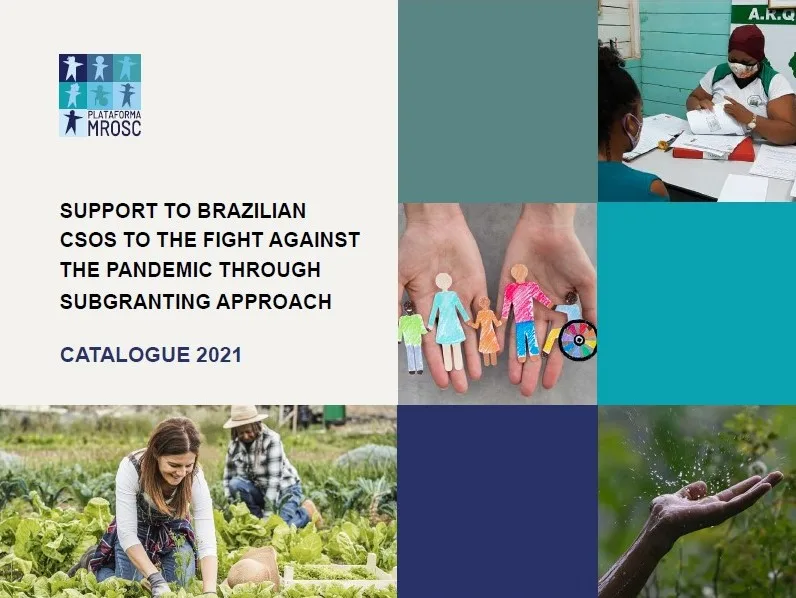
The MROSC Platform, as a Political articulation dedicated to Strengthening Civil Society Organizations and the Environment for their performance, also focuses its activities and efforts on Combating the Dissemination of Covid-19. Two public notices Were issued in 2021 to support project actions in the areas of health, Education, social Assistance, Human Rights, Culture, Environment and Promotion of gender Equality.
Learn more: Catalogue of Emergency Projects to Combat Pandemic Approved in 2021
Texto completo (transcrição)
SUPPORT TO BRAZILIAN
CSOS TO THE FIGHT AGAINST
THE PANDEMIC THROUGH
SUBGRANTING APPROACH
CATALOGUE 2021
INTRODUCTION
THE IMPACT OF THE PANDEMIC FOR CSOs
T
he pandemic of the new coronavirus is yet having consequences in 2021
and making thousands of victims in Brazil and the world. Besides the effects
On the one hand, the 03.2021 Notice was intended for the exclusive support of
State MROSC Platforms with shares of up to R$ 25,000.00 each, being 10 received
on public health, the disease also impacted the Civil Society Organizations
(CSOs), that face enormous challenges with the need for social isolation and loss
of budgetary ties. The current situation is particularly critical for the CSOs due to the
sudden and substantial loss of sources of income.
proposals and 5 contemplated. The 04.2021 Notice, on the other hand, was a call
to the signatory entities of the Platform for the presentation of projects. In total, 113
proposals were received and 20 actions were approved.
From the beginning, CSOs stood out as protagonists in combating the effects
of the pandemic, taking the front line in reducing impacts, seeking to meet the
most vulnerable populations and their most emergent demands. In addition to being
partners of the public power, in the execution of activities in several areas, they
cause high social impact in their surroundings.
The MRSOC Platform, as a political articulation dedicated to strengthening the
Civil Society Organizations and the environment for its action, also focused its
activities and efforts in combating the spread of Covid-19.
In this sense, the platform allocated R$ 320,000.00 to combat the effects of the
pandemic in Brazil and released two calls for proposals in 2021 to support small
projects (subgranting approach) in the following axes:
i. Initiatives in response to the effects of the pandemic and social isolation; and,
ii. Strengthening Civil Society through the enabling of the means¬ required for
the maintenance of activities;
It should also be noted that the selected projects are inserted in the areas of health,
education, social assistance, human rights, culture, environment and promotion
of gender equality, which promote a multiplier effect beyond the budgets’ nominal
economic value. Therefore, they meet the five core points of the MROSC Platform.
Adapted to the new reality imposed by the pandemic of the new coronavirus,
the transfers maintain partnerships, purchase of food, cleaning, hygiene and food
products, preparation of printed and digital materials for information, infrastructure
and acquisition of equipment.
Consequently, 25 projects were selected in total, from the five regions of Brazil,
in the following states: Acre, Amazonas, Bahia, Espírito Santo, Distrito Federal,
Maranhão, Mato Grosso do Sul, Pará, Rio de Janeiro, Rio Grande do Sul, São
Paulo and Sergipe.
This catalog, organized from the regions, brings a compiled with the description
of the actions supported, the main activities, audiences benefited, CSOs involved
in the implementation, resources intended for each project and the territorial
coverage.
The support is part of the action “Fortalecimento e Regionalização da Plataforma
MROSC” (Strengthening and Regionalization of the MROSC Platform), cofinanced by the European Union in Brazil which aims at strengthening the territorial
bases of the platform, the implementation of the federative agenda of the MROSC
and the improvement of the legal, political and institutional environment for the
performance of CSOs.
We wish you a good read!
Project Team
3
Tap the desired region to go to
the corresponding block
11
5
Northeast
North
Bahia
Maranhão
Pernambuco
Sergipe
Acre
Amazonas
Pará
3
5
Midwest
25
Southeast
Distrito Federal
Mato Grosso do Sul
Espírito Santo
Rio de Janeiro
São Paulo
TOTAL:
projects
1
South
Rio Grande do Sul
MIDWEST
DISTRITO FEDERAL
MROSC PLATFORM
State: Distrito Federal
3
Distrito Federal
Mato Grosso do Sul
4
GO BACK TO MAP
Localization: 32 Administrative Regions of Distrito Federal.
Total value: €4,520.80 / R$25,000.00
CSOs involved in the execution: (1) Fundação ESQUEL; (2)
PA- SES; (3) Coletivo Motirô; (4) Azulim; (5) FESHOLNA.
Beneficiaries: 10 CSOs from various Administrative Regions
of the Distrito Federal. In addition, the State Platform will make
available registration for other organizations to inform what is
needed to continue their actions to combat the effects of Covid-19.
Description: The MROSC Distrito Federal Platform will carry out
an internet campaign, register donors to receive items of basic
needs, being companies or individuals and a group of signatory
institutions that are facing Covid-19 with the presentation of actions
carried out. The State Platform understands that one of the big
bottlenecks of institutions in the territory is the search for donations
and their delivery. The action will also support logistics work, through
the storage of donations in deposits of strategic organizations in
two regions of the DF (Samambaia and Sobradinho) and support
through cost and fuel help to the institutions involved in the search
and organization of the donations.
CLUBE E ESCOLA DE
RUGBY SAMAMBAIA
State: Distrito Federal
Localization: State coverage.
Total value: €1,808.14 / R$10,000.00
Beneficiaries: 75 women heads of household, primarily black
women, with no income and with more than two dependents,
living in regions of social vulnerability.
Description: In order to ensure food of the community, the
Samambaia Rugby highlighted in 2020 a fundamental problem: the
autonomy of the peripheries. Food baskets that the organization
called “Large Food Basket”, a new social technology that allows
the collection, availability of balance and the assembly of the
kits by the family members themselves. In partnership with other
organizations, initiatives and community leaders, 75 heads of
family will be registered in areas of vulnerability and who have
suffered from the aggravation of the Covid-19 crisis throughout
the last year. Following this, each family will be able to make
their purchases on the platform, independently or with the help
of the volunteer team. In any case, family members will have
total freedom to assemble the large baskets and compose the
kits according to their needs. Finally, deliveries will be directly
made in the houses, respecting all the necessary safety and care
protocols to prevent the spread of the pandemic. The action will
benefit families, as well as a local economic upturn and value the
city’s businesses affected by the last year crisis. In addition, the
process of communication and experience promotes the defense
of citizen autonomy.
5
75
women are heads
of household
290
Indigenous
people served
INSTITUTO PARA
O BEM VIVER
State: Mato Grosso do Sul
Localization: Indigenous communities
in urban contexts in the municipality of
Aquidauana.
Total value: €1,808.14 / R$10,000.00
Beneficiaries: 73 Indigenous families; 290
of them are Indigenous adults and children.
Description: The project will strengthen
actions to support Terena Indigenous
families in urban contexts. Through the
project, the purchase of food will be carried
out for the assembly of food baskets that
will be headed to Indigenous femaleheaded households without work and in
a situation of social vulnerability, in an
urban context. and without support due to
Covid-19. These women are registered in
the Bem Viver Institute and already receive
support.The Institute will also promote
guidance on personal hygiene care for
the non-spread of the Covid-19 virus. The
impact will be with the guarantee of the
food on the table of the families and with
the direct purchase of the products of the
workers of family farming, supporting the
ones in pandemic time.
6
Northeast
BAHIA MROSC PLATFORM
State: Bahia
Localization: Irecê, Sertão do São Francisco, Remanso and Salvador.
11
Bahia
Maranhão
Pernambuco
Sergipe
7
GO BACK TO MAP
Total value: €4,520.80 / R$25,000.00
CSOs involved in the execution: Executive Coordination of the
Bahia Platform: (1) Associação de Moradores do Conjunto Santa
Luzia; (2) ELO Ligação e Organização; (3) Instituto Odara; (4) Serviço
de Associações e Organizações Populares Rurais; (5) Instituto Vida
por Vida; (6) Cipó Comunicação; (7) IRPPA; (8) CECUP.
Beneficiaries: 125 families, with the following composition: 125
women, 95 men, 150 children, 70 adolescents, being able to reach
Indigenous people and LGBTQIA+.
Description: The MROSC Bahia Platform intends to set up a structure
of the operational secretariat, through the acquisition of a laptop
and a mobile phone with recharging programmed for the execution
of the project, being the function exercised by the proposer, which
will contribute for a process of dissemination of the actions of the
platform. The secretariat will offer support for collegiate coordination
at meetings and in monitoring the actions of the Bahia platform. The
project will also support the signatories by articulating cooperatives to
supply 125 food baskets in the mapped territories. Thus, the Platform
will articulate with the CSOs to be benefited the mapping for delivery
of the baskets. This action provides local CSOs to continue their
humanitarian aid activities, reducing the hunger of the families served
and strengthening the institution.
ASSOCIAÇÃO INDÍGENA KIRIRI DA
ALDEIA PAU FERRO
State: Bahia
Localization: Kiriri indigenous territory, in the municipality
of Banzaê.
Total value: €1,692.59 / R$9,360.00
Beneficiaries: 45 Indigenous families.
Description: Prevention actions will be organized,
mobilization and the creation of strategies that can battle
the spread of Covid-19 in the Indigenous territory. The
project will stimulate the community to value Indigenous
health and traditional knowledge to protect themselves.
In this regard, masks will be acquired, food baskets,
cleaning and hygiene products, to ensure the isolation
of Indigenous people. A commission will also be formed
to develop the activities, with the involvement of young
people, artisans and zabumba of the village
8
45
Indigenous
families
Valorization of
Indigenous health
FUNDAÇÃO DE DESENVOLVIMENTO
INTEGRADO DO SÃO FRANCISCO FUNDIFRAN
State: Bahia
Localization: Land reform settlement Manoel Dias, municipality of
Muquém do São Francisco.
Total value: €1,808.14 / R$10,000.00
Beneficiaries: 29 people, members of the Joca Sabores group,
which is composed of 20 women and 09 young people between 15
and 25 years, being 06 female and 3 male.
9
Contributing to
family income
Description: The support will be granted to the group Jovens e
Mulheres Camponesas em Ação (Joca Sabores), from the Land
reform settlement Manoel Dias. Due to the Covid-19 pandemic,
the production of sweets, jellies, sweets, juices, cakes and breads
is made in the family grouping and the sale has been carried out
online by the young people of the group. The aim of the proposal is
to contribute to the family income through the following actions: 1)
Acquisition of raw material for the production, which will contribute to
keep the group producing, for another 06 months. The funds raised
from the sale of the products will be allocated to the Fund (working
capital), to keep the kitchen running; 2) Cost aid for Indigenous
families with the acquisition of foodstuff, each family will receive,
as a cost aid for their production work with the group, a basket with
food items for a period of 2 months
CENTRO DE ESTUDOS
E AÇÃO SOCIAL
State: Bahia
Localization: Salvador, South and Northeast region of
Bahia.
Total value: €1,808.14 / R$9,999.00
630
served
people
Beneficiaries: 180 families, being 630 people, including the
30 settled and camped families of the Agrarian Reform of
the CETA Movement. Of these are 150 women, 150 men
and 330 young people, children and adolescents.
Description: In this context of food insecurity intensified by
the pandemic, which has imposed numerous challenges for
popular organizations, this proposal seeks to strengthen a
solidarity alliance between the countryside-city, through the
acquisition of agroecological baskets produced by families
in areas of agrarian reform and food security aid for families
organized in urban social movements, which are in the
struggle for decent housing. From this web of solidarity,
in order to face the pandemic context, this support will
contribute to the resistance of the people from the countryside
and the city in the territorial defense for the production and
reproduction of life. The beneficiary families are in ¬food and
nutritional insecurity in peripheral communities of Salvador
and will receive baskets of agroecological food produced
by the CETA-South Movement. There are 30 rural working
families that are producing through the agroecological
system in areas of agrarian reform.
10
strengthening
a solidarity
alliance
between the
countryside
and the city
Distribution of
hygiene and
cleaning kits for
approximately
300
people
ASSOCIAÇÃO DOS PRODUTORES
REMANESCENTES DO QUILOMBO
DE QUEIMADA NOVA
State: Bahia
Localization: Municipalities of Capernaum and Jacobina and in the territories
Chapada, Irecê, Piemonte, Diamantina; Quilombos de Queimada Nova, Morro
do Chapéu and Território de Identidade Chapada Diamantina.
Total value: €1,808.14 / R$10,000.00
Beneficiaries: 85 families of Quilombo de Queimada Nova, which total
approximately 300 people, 84 women, 74 men, 55 elderly, 40 adolescents, 35
children and 3 people with disabilities
Description: The impacts of the pandemic were tearing for the world’s
population and, for the black population, they were much more severe. Deaths,
unemployment, hunger and families entering the line of extreme poverty have
-directly reached the quilombola population that lives in the rural area on the
margins of society. Through the project, the CSO will distribute hygiene and
cleaning kits to families in Quilombo de Queimada Nova. To enhance the
production of cakes and biscuits, there will be the acquisition of inputs to supply
the stock. They will be delivered to the women’s collective, with guidelines for
disposal and hygiene of packaging. For the infrastructure of the Association, It
will be acquired a computer with a printer to enable remote work, print of labels
for products and other diverse digital services. With this, the Association will
be able to provide the products for school meals that by then the women had
given up for lack of inputs. The masks of the hygiene kit will also be produced
in quilombo, the community will feel well greeted and household income will
increase with the sale of the produced products.
.
11
CENTRAL DAS ORGANIZAÇÕES
COMUNITÁRIAS DE MENINO JESUS
State: Bahia
Localization: Candeias, Metropolitan Region of Salvador.
Total value: €1,808.14 / R$10,000.00
Beneficiaries: 100 black families with children, being 60 female
and 50 male, 0 to 11 years of age; 40 female and 30 male
adolescents, from 11 to 17 years old, 20 elderly; 80 young adults
male and 80 female, from 18 to 59 years; 12 male and 8 female
quilombolas.
12
Serving more than 100 families in
situation of social vulnerability
Description: The project will strengthen the team and the
actions of intervention aimed at helping families in a situation
of risk and social vulnerability. These actions seek to meet the
needs of least privileged families, composed of adolescents and
the elderly, as well as of family nucleus with people with special
needs and people in street situation. The emergency action,
carried out in conjunction with partners, will reduce hunger,
vulnerability, social risk of breaking ties, and strengthen the
entity, the management of the organization and the purpose of
representing users transparently, with equity and social justice.
Developed actions: distribution of food baskets composed of 14
items, personal protection masks and educational brochures
with tips for protection and prevention of contamination.
140
served people
INSTITUTO DE AÇÕES
SOCIOAMBIENTAIS – INASA
State: Maranhão
Localization: Quilombola Soledade Community, in the municipality of Caias.
Total value: €1,542.50 / R$8,530.00
Beneficiaries: 140 people, being 20 homeless people: 06 men
and 4 women; 30 families (total of 90 people), being 60 women
and 30 men, and of these, 10 elderly people and 30 children, up
to 10 years.
Description: The Institute has as a source of resources its own
actions, through sustainable workshops and production from
recyclable materials. Given the pandemic, there was a reduction
in waste consumption and production. The INASA was out of
the main raw material. With this resource, INASA will promote
social actions, which will ensure the continuation of practices, as
well as contribute to the fight against the pandemic of the new
coronavirus with public and private agencies. The action will
provide greater performance in the community, since INASA is
the only socio-environmental entity in the municipality. In addition,
it will be distributed ready-made food (take out food), food baskets
and protection and hygiene kit. A volunteer from the institute will
visit the homes, making the registration according to the municipal
protocol of pandemic control and conducting dialogues about
the moment. Therefore, the proposed action seeks to impact
communities around INASA.
13
PERNAMBUCO MROSC PLATFORM
State: Pernambuco
Localization: National coverage.
Total value: €4,520.80 / R$25,000.00
CSOs involved in the execution: (1) Associação dos Filhos e Amigos de
Bezerros – AFAB; (2) APAE Paulista; (3) Consultoria MAIS Social; (4) Centro
Sabiá; (5) SERTA; (6) CDC; (7) Cáritas Brasileira Regional Nordeste II.
Beneficiaries: 100 representatives of signatory entities with diverse types
of audiences: elderly/disabled people, children, adolescents, LGBTQIA+,
among others.
Description: The project will strengthen the signatory institutions of the
MROSC Pernambuco Platform, as well as contribute to the strengthening
of other state platforms, mobilizing CSOs about the holding of municipal
conferences of the various segments: health, education, social assistance,
elderly, people with disabilities, culture and others. The aim is to provide
information and strategies necessary for the organized civil society to
influence and actively participate in the construction of the Platform in the
Multiannual Plans (PPAs) and their interactions with the application of the
MROSC in the execution of public policies. In addition, the Coordination of
the MROSC Pernambuco Platform will be strengthened with other related
agents, such as: Public Administration, Public Prosecutor’s Office, Court of
Accounts, Accounting Board and OAB. In this way, three thematic webinars
will be held with the focus on the MROSC and the PPA and a forum that
will gather several actors active in the MROSC agenda with the following
theme: Strengthening CSOs and the MROSC Platform in Pernambuco.
The project will also strengthen the MROSC Pernambuco Platform through
the structuring of the articulation’s social networks.
14
100
CSO managers
ASSOCIAÇÃO DA REDE
DE MULHERES PRODUTORAS
DO PAJEÚ
State: Pernambuco
Localization: Region of the Sertão do Pajeú, with regional coverage,
in the following municipalities: Afogados da Ingazeira, in the urban
residencial community Laura Ramos; Iguaracy, in the rural community of
Caruá; São José do Egito, in the rural communities of Retiro, Curralinho,
Açude da Porta and Riachão II; Flores, in the rural communities of Pereiros
and Saco do Romão; Carnaíba, in the rural quilombola communities of
Abelha and Brejo inside.
Total value: €1,795.66 / R$9,930.00
Beneficiaries: 150 rural women farmers and other women from outlying
neighborhoods of the Pajeú, and indirectly an average of 200 children
and adolescents and 80 elderlies.
15
150
women farmers
served
Description: Rede de Mulheres Produtoras do Pajeú is constituted as a
grassroots association formed by rural farmer women and poor women
from urban peripheries of several municipalities in the region. The
requested resources will contribute to the continuity of the organization’s
work and will strengthen the articulation of the institution along with its
members and women’s groups that are members of the CSO. Hygiene
and cleaning kits will be purchased and distributed, which will be
delivered to women in related communities. For this delivery logistics
will be mobilized partner organizations that also operate in the territory.
The Workers’ and Rural Workers’ Unions of the municipalities are
reference points for the farmers and they are also partners in the action.
The women beneficiaries of the project participate in the Associação da
Rede de Mulheres Produtoras, and, with this, the action will strengthen
the organization of women and minimize the impacts generated by the
pandemic with the delivery of the kits.
GESTOS: SOROPOSITIVIDADE,
COMUNICAÇÃO E GÊNERO
State: Pernambuco
Localization: Recife and Metropolitan Region.
Total value: €1,795.66 / R$9,930.00
Beneficiaries: 88 people living with HIV and AIDS, being
27 adult men (gay and heterosexual), 50 adult women,
09 trans women (08 adults and one young woman) and
02 young women.
Description: Gestos has been dealing for 28 years with
the population that lives with HIV and AIDS in a situation
of social, economic vulnerability and that still faces
stigma and prejudice, sometimes from the family itself.
The support of these resources, at this time, represents
ensuring food safety to people who do not have other
spaces or social programs that can meet their demands.
A population that needs continuous use of medicines to
stay alive, but without food will not be able to maintain
adherence to the treatment. For Gestos it is essential to
ensure food security by having healthy food for people
who live with HIV and are in the peripheries in a situation
of poverty. The resource made available will be used to
ensure food for people living with HIV and AIDS served
by Gestos.
16
88
served people
SERGIPE MROSC PLATFORM
State: Sergipe
Localization: Aracaju, Nossa Senhora do Socorro, Poço
Redondo and Canindé do São Francisco.
Total value: €4,520.80 / R$25,000.00
CSOs involved in the execution: (1) Centro de Integração Raio
de Sol – CIRAS; (2) Centro Dom José Brandão de Castro – CDJBC; (3) Instituto Nacional de Inclusão Social – INIS.
Beneficiaries: 333 people, among them, elderly, adults, children,
adolescents and people with disabilities. All in risk and social
vulnerability situations.
Description: The MROSC Sergipe Platform will support
families who are or have already been served by the platform’s
signatory organizations. Families who have been affected by
the pandemic of the new coronavirus or who are in a situation
of social vulnerability. Through the delivery of food baskets, the
goal is to minimize the effects of the pandemic. The delivery will
be based on the survey carried out by said organizations with
signatures of receiving lists and photographic records. The action
will also provide local trade movement generating income for
small traders. The MROSC Sergipe Platform believes that, when
the crisis is overcome, the action of organizations and social
movements, post-committee, will enable a greater dialogue with
society in general, as well as, possible new partnerships of the
private sector.
17
333
benefited
people
North
ACRE MROSC PLATFORM
State: Acre
Localization: Rio Branco.
5
Acre
Amazonas
Pará
18
GO BACK TO MAP
Total value: €4,520.80 / R$25,000.00
CSOs involved in the execution: (1) Rede Ecocidadania; (2)
Aredacre; (3) Aborda; (4) Agá & Vida; (5) Unisol; (6) Cáritas
Diocesana de Rio Branco.
Beneficiaries: 200 families, with an average of 1000 people.
Of these: 140 women housewives with an average of 3 children
per residence; being 80 women solo mothers. In addition,
10 families of migrants with children; 20 families headed by
elderlies with children in their homes; 20 LGBTQIA + families
and 10 people with disabilities.
Description: The flood that hit Acre, the Covid-19 pandemic
and dengue fever, brought the need to move away from work
activities. The MROSC Acre Platform with the other signatories,
in this moment of public calamity, will develop actions for the
acquisition and delivery of non-perishable food (200 food
baskets) including cleaning products for population in situations
of social vulnerability that have not been taken into account with
the help of other initiatives. This action will help minimize the
suffering of families who are in extreme poverty to have the
minimum necessary in this difficult time, generating self-esteem
and solidarity action in communities.
ASSOCIAÇÃO RIO BRANQUENSE
DE DEFICIENTES FÍSICOS – ARDEF
State: Acre
Localization: State and municipal coverage in Rio Branco.
Total value: €1,805.23 / R$9,982.90
Beneficiaries: 30 families.
Description: ARDEF is an association of people with
physical disabilities that has objectives aimed at promoting
activities and purposes of public and social relevance.
Faced with the global health crisis caused by Covid-19,
unemployment has increased and families are experiencing
difficulties to bring food to the table. Through this project, in
partnership with organized civil society, the CSO will seek to
avoid the interruption of essential services provided, as it will
ensure the basic functioning of the Association and will give
conditions to make payments of electricity bills, telephone
and internet. In addition, it will acquire equipment that gives
conditions to record the activities and participation through
social networks. There will be the distribution of food baskets
and protection kits, hygiene and cleaning materials.
19
Payment of
electricity, telephone
and internet bills
30
Served
families
food baskets
and hygiene kits
PONTO DE CULTURA CONEXÃO
AFRO AMAZONAS
State: Amazonas
Localization: State and national coverage.
Total value: €1,808.14 / R$10,000.00
Beneficiaries: 300 families, mostly made up of women head of
household, being 200 women, 420 children and 180 men, between
father of family and young black boys and ameríndios. In addition,
20 families of recent Venezuelan immigrants all families headed
by women; 15 Indian women, 20 quilombola women.
Description: Ponto de cultura will carry out workshop projects
with a focus on the elaboration of artistic projects with the aim of
preparing the artists in the making of their projects and present
proposes for notices. Through the planned activities, it will be
available the adaptation for the remote work of the CSO, from
the requalification of the team and purchase of equipment for
recording studio. With this, it will be possible to carry out lives,
video lessons and formation of action groups. As a final product,
the project’s e-book will be prepared, a 30-minute documentary
with a summary and testimonials of the workshops developed in
the period. In addition, there will be distribution of food baskets
and cleaning and hygiene kits. The project will foster the formation
and generation of minimum income, food security, development
of culture and creative economy
20
300
benefited
families
Distributed food
baskets
ASSOCIAÇÃO FOLCLÓRICA E
CULTURAL COLIBRI DE OUTEIRO
State: Pará
Localization: Ilha de Outeiro.
Total valor: €1,415.10 / R$7,500.00
Beneficiaries: 50 families, with about 200 people.
Description: The Association will buy food baskets to
help children, young people and their families, majorly
headed by women. Thus, they will have courage to
face the Covid-19 pandemic situation. Most of the
actions of the association are focused on culture and
are totally paralyzed. In total, they will distribute 50 food
baskets that will help women and their families to keep
themselves, minimizing the situation of hunger. The
distribution will be made by mobile phone connection
or via text application. The impact of the project results
in ensuring adequate food for families, as many are
without jobs, without food and in a situation of social
vulnerability.
21
200
served people
ASSOCIAÇÃO DAS COMUNIDADES
REMANESCENTES DE QUILOMBOS DO
MUNICÍPIO DE ORIXIMINÁ – ARQMO
State: Pará
Localization: 37 quilombola communities distributed in 08
territories in the municipality of Oriximiná, Western Region
of the state of Pará, called Calha Norte.
Total value: €1,790.24 / R$9,900.00
Beneficiaries: 9,500 people, being 5,000 quilombola women and 4,500
quilombola men.
9.500
served people
22
Description: The support granted to ARQMO will benefit all 37 municipalities
countries which are unable to leave the territories due to the increased
spread of the pandemic at the headquarters of the municipality. The great
challenge at this time is to safeguard the health and integrity of the quilombola
peoples, avoiding community contagion, as well as guiding them on the
risks of contamination and adopting preventive measures in accordance
with the health bodies. In this sense, the CSO will make the acquisition
of computer equipment to control the actions that are being carried out in
quilombola communities: consolidate the database; control the quilombolas
that received emergency aid and the two doses of the vaccine; support
to quilombola students in the Special Selection Process Quilombola/2021
of the Federal University of Oeste do Pará and the Federal University of
Pará; contribute to the administrative work of the association and support
through folders, videos, publications in the campaigns to combat Covid-19
in the communities. The impact will be through the activities developed by
ARQMO within the quilombola communities, as well as the sharing with the
coordinators of the associations of territory, community coordinators and
other institutions.
Southeast
COLETIVO DE FORTALECIMENTO E EMPODERAMENTO
DA POPULAÇÃO NEGRA DO SUL DO ESTADO – ES
State: Espírito Santo
5
Espírito Santo
Rio de Janeiro
São Paulo
23
GO BACK TO MAP
Localization: Joacima and Morro do Cemitério, Quilombo de Graúna – Itaipava/
Itapemirim, Quilombo of Cacimbinha and Boa Esperança in Presidente Kennedy, Morro
do Zumbi in Cachoeiro de Itapemirim, Morro da Rua da Erubra e Espinha de peixe in
Marataízes, Vale do Orobó (Rural) in Piúma, southern region of Espírito Santo.
Total value: €1,801.76 / R$9.963,70
Beneficiaries: 64 families will be served, being 47 families of the black population: 28
quilombola families and 19 urban peripheral families, including elderly, women, solo
mothers, men, children, young people and people with disabilities. 03 gypsy families,
05 rural families, 03 families with people with disabilities, 06 families of the LGBTQIA+
population.
Description: Coletivo was born in 2014 from the reflections of black women, who
suffered institutional racism for occupying positions that were once only for white
people, in order to overcome, confront and combat all forms of discrimination and
inequalities. In this context, the project will strengthen initiatives of the collective during
the pandemic and beyond, as it will support people with cancer through donations of
food baskets, hygiene kits, children’s snack kits, geriatric diapers and supplementary
milk. To strengthen the Coletivo, overdue bills will be paid and there will be purchases
of a printer to help mothers and children who have virtual classes, do not have internet
to search and print the activities. The resource will promote mobilization of proactive
engagement, with the leaders, awakening the critical sense for carrying out political
incidences, such as strategies to guarantee rights. Each kit will be delivered with
two kits: one on facing domestic violence and the other on social control. The goal of
humanitarian actions will be to empower communities and make them creative and
sustainable
ASSOCIAÇÃO EXPERIMENTAL DE
MÍDIA COMUNITÁRIA – BEMTV
State: Rio de Janeiro
Localization: Niterói and São Gonçalo
Total value: €1,808.14 / R$10,000.00
Beneficiaries: 15 adolescents and young people aged between 16 and
29 years, 8 of whom are female and 7 of whom are male, an active
search vacancy for adolescents with disabilities.
Description: Communication is a human right, and the association
works to strengthen young people to fight for rights. The circulation of
safe information, an issue for every society, gets worse more in the
slums, making them more susceptible to fake news or misinformation.
The project faces this situation through the training of 15 young
communicators who work checking and producing information on health
and fundamental rights, working as an organic network of popular
communication in the slums of São Gonçalo and serving as a direct
channel with the local population. With this resource will be maintained
the basic actions with 15 young people working in the Bom Retiro
complex in São Gonçalo and communities of Niterói already mobilized,
slums with low access to income and little supply of public services. The
association will ensure the continuity of the training processes offered
in conjunction with teachers of the Institute of Collective Health of the
Federal Fluminense University, aiming to broaden health information,
especially on the coronavirus, forming young communicators to check
and share health information. It is emphasized that the option will be
for the monthly stipends and not for the distribution of food baskets,
because the association defends autonomy, understanding that the
guarantee of food safety needs to be intrinsically articulated with the
income guarantee.
24
15
young
communicators
being trained
ASSOCIAÇÃO EDUCACIONAL
ARAUJO DUTRA
State: Rio de Janeiro
Localization: Slums of the North Zone,
neighborhoods of Acari, Anchieta, Costa Barros,
Guadalupe, Honorio Gurgel and Pavuna.
Total value: €1,702.80 / R$9,416.50
Beneficiaries: 50 women over 15 years of age.
25
50
Description: The Educational Institute Araujo
Dutra started the work of assistance to children and
adolescents in extreme poverty situations, living
in the Palmeirinha slum, in the year 2006. When
contacting families, the institute came across the
reality of young single mothers and elderly women
who care for their children and grandchildren. Since
then, the CSO seeks to execute the projects with
women who act alone as providers and caregivers.
Therefore, the Institute will focus on the Food Safety
Program with food basket deliveries. It will also be
organized and mobilized a core of black women
as community leaderships, to receive support in
the professional development and strengthen a
set of voices to confront violence against women,
children, adolescents and the elderly, severe in this
moment of social isolation.
served
women
ASSOCIAÇÃO CASA HACKER
State: São Paulo
Localization: National
Total value: €1,808.14 / R$10,000.00
Beneficiaries: 30 CSOs, groups and/or collectives throughout the national territory
Description: Before the pandemic, many CSOs, groups
and groups, especially those of community base, had
their communication very localized and territorialized;
students, then, poorly use the information technologies
to communicate with their target audiences. Training
brings numerous possibilities to boost the work of the
organization: engaging volunteers and donors, amplifying
their voices, focusing on public policies through digital
marketing strategies, as well as ensuring the contact of
the organization with its beneficiaries and strategy public
during the pandemic. The action will be aimed at Digital
Marketing and Volunteer Management Training with
the aim of empowering CSOs, groups and collectives to
create their visual identities, digital presence and mobilize
volunteers in order to disseminate their cause and achieve
greater visibility to qualify the organization’s communication
actions. This course will be divided into modules for better
absorption of information and knowledge. The course will
be approximately 30 hours long and will be broadcast online
to registered organizations, later made available openly on
Casa Hacker’s YouTube.
26
30
CSOs are
benefited
Training
in Digital
Marketing
and Volunteer
Management
INSTITUTO REDES PARA
O DESENVOLVIMENTO
State: São Paulo
Localization: District of Brasilândia, northwest region of the city
of São Paulo.
Total value: €1,808.14 / R$10,000.00
Beneficiaries: 2,000 people directly in 400 families.
Description: Instituto Redes articulates the Solidarity
Consumption Network that emerged with the aim of supporting
the families of the Sustainable Development Project (PDS) Dom
Pedro Casaldáliga, in Cajamar, through the farmers of COOPEC
Cooperativa Agroecológica São Luiz de Cajamar. The aim is to
promote the direct acquisition of natural, agricultural and organic
food for distribution to families through the cooperation network
formed in peripheral communities. This initiative will promote,
in the District of Brasilândia, the face of food and nutritional
insecurity through the acquisition of agroecological, organic
and artisanal products directly from rural producers, enabling
the generation of income and the distribution of food to families,
groups and peripheral communities in vulnerable situations.
The products offered in these product baskets will complement
the other food groups not included in the food baskets already
offered/distributed by the partner organizations. In this way, it
brings organic and agroecological food to the table of peripheral
families, values the work of producers who respect nature,
protects ecosystems and brings the fruit of the work of rural
families closer to consumers.
27
2000
served
people
South
SOMOS – COMUNICAÇÃO, SAÚDE
E SEXUALIDADE
State: Rio Grande do Sul
1
Rio Grande do Sul
28
GO BACK TO MAP
Localization: Porto Alegre
Total value: €1,802.90 / R$9,970.00
Beneficiaries: 100 LGBTQIA+ people and/or living with HIV/Aids,
prioritizing women and non-white people.
Description: LGBTQIA+ populations and living with HIV/Aids
are an integral part of the population segments most affected
by the Covid-19 pandemic, either from a health perspective or considering the health vulnerability – whether from a material point
of view – given the limitations of insertion of these populations in
the world of work, especially at this time of closure of commercial
establishments and decrease of job vacancies. Considering this
scenario, the project will offer material emergency support, legal
and psychological assistance, considering the damage of the
epidemic not only in the lack of resources for food, but also in mental
health and access to social rights of these populations. In addition,
SOMOS will expand the service provided from the possibility to
offer food baskets and/or hygiene, cleaning and protection kit for
those who are hosted. The populations of LGBTQIA+ people and
living with HIV/Aids already suffered a process of vulnerability of
life, which is accentuated today. The pandemic moment demands
that the fight for the rights of these populations turn to subsistence.
CÁRITAS
BRASILEIRA
This overview was prepared with the exclusive participation of the MROSC Platform,
and cannot, under any circumstances, be regarded as reflecting the position of the European Union.
TECHNICAL INFORMATION
Preparation: Candice Araújo, Igor Ferrer, e Luise Villares.
Revision: Eliana Rolemberg, Igor Ferrer e Luise Villares.
Communication Advisory: Nívea Martins Pereira e Isis Dias.
Diagram: Mateus Leal.